By Dr. Syrulwa Somah
INTRODUCTION: A DIFFERENT KIND OF INDEPENDENCE
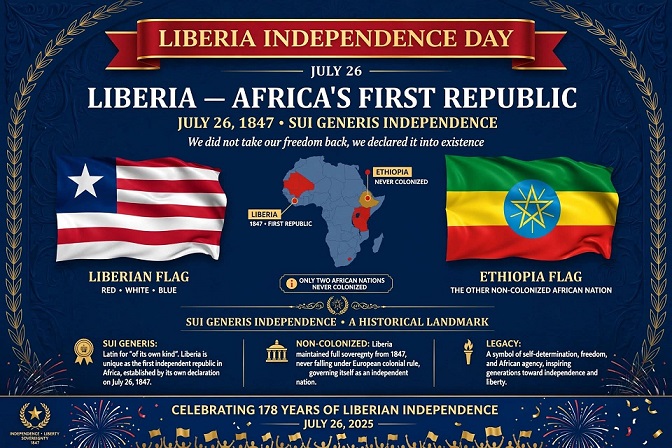
As Liberia prepares to celebrate July 26th, we must teach our students and citizens a truth that confuses many. Liberia's independence is not like the rest of Africa's independence. To understand this, we must use the correct academic term: Sui Generis Independence.
Sui Generis is Latin for of its own kind or one of a kind. Sui Generis Independence is when a nation becomes independent not by fighting to end European colonization, but by declaring itself a new sovereign state where no internationally recognized state existed before. It is independence by creation, not independence by liberation.
The rest of Africa experienced Decolonization Independence. Ghana fought Britain. Guinea fought France. Congo fought Belgium. They had to take their freedom back.
Liberia and Ethiopia are the only two nations in all of Africa that have Sui Generis Independence. Ethiopia had ancient sovereignty it defended. Liberia had no European master. The American Colonization Society that governed us before 1847 was a private American organization, not a European government. On July 26, 1847, 272 property owning men did not reclaim a country. They constituted, meaning they created, a new country called the Republic of Liberia and wrote a Constitution. We did not take our freedom back. We brought our freedom with us and declared a new free nation into existence. This is why we are Africa's first Republic.
HOW THE ANTEBELLUM PLANTATION CULTURE LIMITED WOMEN'S RIGHTS
If our independence was unique in how it began, it was common in its flaws, because it carried the culture of the antebellum South.
The culture of the antebellum South and its slavery plantation system directly influenced and limited women's voting rights in ACS Liberia, and in its Declaration of Independence and Constitution of 1847.
While this was wrong, it was a reflection of its time. It was a man's world in that era. The American Colonization Society was led largely by Southern slaveholders, and the settlers were free Blacks who had lived their entire lives under that Southern patriarchal system. In that world, politics, land ownership, and public life were defined as male domains.
When the settlers came to power in Liberia, they imposed the only model they knew, a plantation model that divided society between civilized masters and savage workers, where only the male head of household could speak for the family, own land, and govern.
This was codified in law. In antebellum America, federal and state governments universally denied women the right to vote because wives were legally covered by their husbands under the doctrine of coverture. The early 1800s expansion to universal white male suffrage only made this sharper, exaggerating the difference between men and women.
Liberia copied that formula verbatim. Article I, Section 11 of the Constitution of 1847 states: All elections shall be by ballot and every male citizen, of twenty-one years of age, possessing real estate, shall have the right of suffrage. That single word, male, excluded all women, just as the property requirement excluded the propertyless and non-citizens. This is why only 272 men voted in the July 26, 1847 referendum to create the nation.
The Constitution did protect women as dependents. Article I, Section 10 states that the property of which a woman may be possessed at the time of her marriage and also that of which she may afterwards become possessed shall not be held responsible for the debts of her husband. But in the logic of a man's world, a woman could be protected as a wife or widow, but not enfranchised as a citizen.
CONCLUSION: COMPLETING OUR SUI GENERIS INDEPENDENCE
By today's standards this was unjust. By the standards of July 26, 1847, when no woman could vote anywhere in the United States, it was seen as normal.
That is why Liberia's greatness is not that we were perfect on July 26, 1847. Our greatness is that we have the courage to make our sui generis independence more complete.
We completed it in 1946 when Americo-Liberian women won the right to vote. We completed it again in 1951 when every Indigenous Liberian, man and woman, was finally included as a full citizen with voting rights. We completed it when we became the first African nation to elect a woman President.
So on July 26th, we celebrate two things that make us extraordinary. First, we celebrate that we are a sui generis nation. We did not fight to take our independence. We declared it into existence on July 26th. Second, we celebrate that the independence we declared on July 26th, 1847 now belongs to all Liberians.
The founders gave us independence from the world on July 26th, 1847. The women who fought for the vote from 1920 to 1946 gave Liberian women independence in their own country.
Both deserve celebration on July 26th.
WORKS CITED
1. Liberia. Constitution of the Republic of Liberia, 1847. Article I, Sec. 11 and Sec. 10.
2. 1847 Liberian Constitutional Referendum. 272 voters total, 214 for independence on July 26, 1847.
3. Timeline of women's suffrage. Liberia: 1946 suffrage for Americo women, 1951 universal suffrage.