- Minister Piah
By Hawa Bility
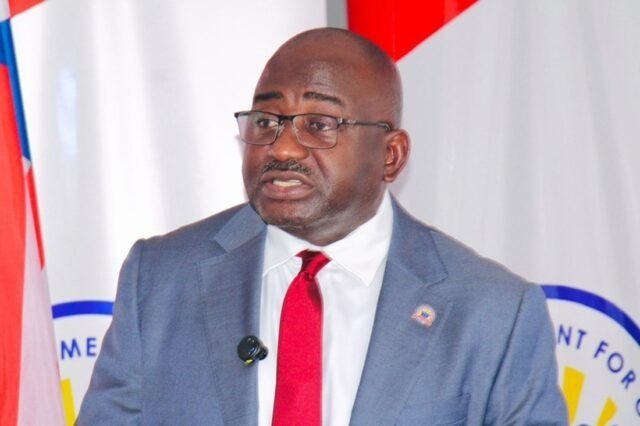
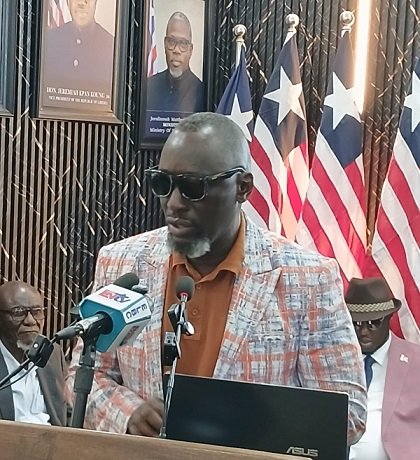
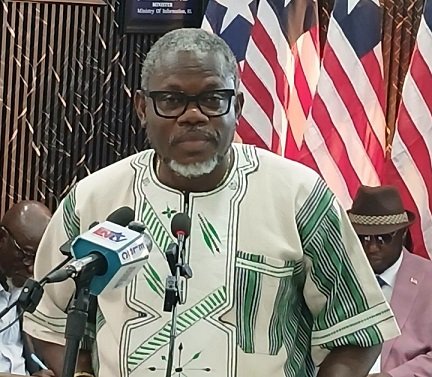
Minister of Information, Jerolinmek M. Piah, has clarified that the defense team of former Vice President Jewel Howard-Taylor, not the prosecution that withdrew its request for a preliminary examination in the ongoing illicit drug case.
Minister Piah made the clarification during the Ministry of information regular Tuesday briefing, rejecting claims that the prosecution objected to the disclosure of evidence during the preliminary hearing.
According to Piah, the former Vice President and her legal team requested the preliminary examination, a request he said was granted by the court.
He explained that under Section 12.2 of Liberia’s Criminal Procedure Law, a preliminary examination in a felony case is conducted only when requested by the defendant.
Minister Piah said the purpose of a preliminary examination is to determine whether there is sufficient evidence, or probable cause, to send a defendant to trial.
He noted that during such proceedings, the prosecution presents basic evidence and witness testimony, while the defense is afforded the opportunity to question and cross-examine prosecution witnesses.
Minister Piah disclosed that prosecution witness, Raphael Wilson, testified during the preliminary hearing that investigators legally obtained voice recordings from Sheikh A. M. Porte, whom he described as an associate of the former Vice President, who was in contact with members of the alleged cartel and facilitated a meeting involving them.
He, however, declined to disclose further details of the testimony, noting that the matter remains before the court.
The Information Minister described as misleading claims by the defense team that the prosecution objected to the disclosure of evidence and that the court sustained the objection.
Minister Piah said it was the defense team, rather than the prosecution, that withdrew its request for the preliminary examination, thereby ending the proceeding before it could be completed.
He said the decision to waive the preliminary examination allows the case to proceed to the Circuit Court, where the trial will take place.
Minister Piah also defended the government’s handling of the illicit drug cases, saying authorities are convinced that the evidence presented against those charged is strong enough to withstand judicial scrutiny.
He emphasized that the government recognizes the need to avoid discussing matters currently before the courts in the court of public opinion.
However, Minister Piah said the government has an obligation to provide clarification when statements made publicly about ongoing cases contain what he described as inaccurate information and misinformation.
He said evidence that was not heard during the preliminary examination can still be presented during the trial proper at the Circuit Court.