By Nvasekie N. Konneh
Some of the worldwide acclaimed West African singers sing in various dialects of the Mandingo language. In Ivory Coast, there are reggae legends Alpha Blondy, Tiken Jah Fokoly, Ismael Isaac; traditional singers like Aichai Kone, or Mamadou Doumbia etc. In Guinea, there were Demba Camara and the Bembeya Jazz National, Sekouba Bambino, Mory Kante of the Yeke Yeke fame, Manfela Kante, all of sainted memory. Currently, the great trailblazers of Guinean music include Djelykaba Bintou, Sekouba Bambino, Azaya, etc. In Mali, there are Salif Keita, Oumou Sangare, Ali Farka Toure, Sidiki Dioubate, and the latest sensation, Zikiri Sourakata Kone. Though from different countries, all these artists are legendary singers in various dialects of the Mandingo language. Though they may sing in different dialects of the same Mandingo language, they represent the same culture and tradition that have lasted for thousands of years across West Africa.
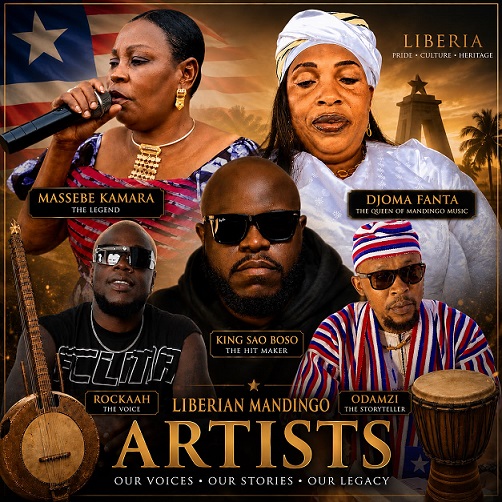
Since 2006 up to present, a new wave of Mandingo artists have emerged in Liberia. Sensational singer Massebe Kamara set the pace in 2006 with her studio recorded Dengo album. She was followed by Djoma Fanta a year later with her album titled, Thiakonie. Both Massebe Kamara and Djoma Fanta were singing in gbumbey clubs and at mamaya programs during normal days in Liberia. They both are from Sanniquellie, Nimba County. Until recently, the only type of Mandingo music in Liberia was gbumbay. Whether in Bong, Nimba, Grand Gedeh, or Lofa, gbumbay songs were sung on occasions like the Eids, marriage ceremonies or other festive occasions.
When we produced Massebe Kamara's album, "Dengo" in 2006, it became the first studio recorded Liberian Mandingo song. As a new phenomenon, it spread like a wildfire in Liberia and Guinea. People were not used to hearing Mandingo music produced in Liberia. That album took Massebe far and near. She mesmerized audiences with her beautiful voice and meaningful songs with masterful instrumental arrangement done by Tony Karbedeh, a respected veteran in the Liberian music industry. Even 20 years after its production, Dengo is still rocking at graduation programs, baby naming ceremonies and other festive occasions in the Mandingo communities at home and abroad. People continue to share the music on social media platforms such as Facebook, Instagram and TikTok.
Djoma Fanta's "Thiakonie" album came out a year later, and it became another great success both in Liberia and Guinea. Today, Djoma Fanta has even grown bigger with her legendary singing voice. There can be no discussion of Liberian Mandingo musical artists today without mentioning her name, along with that of Massebe. Djoma Fanta is well represented on various social media platforms with her own YouTube channel and Facebook page. Sometime people will compare both she and Massebe on social media but I have always maintained that they are both great in their own rights. The both represent the same culture, singing the same traditional songs in different forms.
As already mentioned, both Massebe and Djoma Fanta Fofana were singing in gbumbey clubs during normal days in Liberia. They both sought refuge in Guinea during the war. The gbumbey songs they sing are traditional not just to Guinea and Liberia, it's also deeply rooted in the Ivory Coast. Over the years, gbumbay was mostly performance music rather than recorded in studios. There was one famous singer for whom it was a career. She was Djele Kumba from the Ivory Coast. She used to come to Liberia and was very popular with the Mandingoes in Nimba, Bong, and maybe elsewhere in Liberia. This was the period of the 70s leading to the 80s. Another popular Mandingo singer from Ivory Coast who used to visit Liberia was Mamadou Doumbia. He was a composer, guitarist and singer who formed the group Trio de l’Entente which would become Orchestral de l’Entente. As a veteran musician, Mamadou Doumbia had a big studio in Abidjan. I was a regular visitor to his studio during my refugee days in Abidjan in the early 90s.
Back in the late 70s and the early 80s, the most popular Mandingo singers in Liberia were Fedeli Kromah and Brahima Guitari. These were Mandingo folk singers who were very popular with our mothers and grandmothers. You couldn’t go to any Mandingo home without their cassettes playing in tape recorders. Their songs were very rich in the Mandingo culture and tradition. While Fedeli died much earlier, Brahiman Guitari went on to bigger success with studio recordings in the Ivory Coast. When I met him in Abidjan in 1991 while I was a refugee there, he told me he was a member of the Liberian Frontier Force in his youth days in Liberia. The last time I met him was 2008 during Massebe Kamara's promotional tour in Nzerekore, Guinea. Seeing the soaring popularity of Massebe and Djoma Fanta at the time, he said that he was happy to finally see Mandingo embracing their own music common to the forest regions of Guinea and Liberia. He referred to the ridicule he and others suffered from the same Mandingoes, some of whom, for religious reasons, thought that singing was not an honorable career. Such ridicule did not dissuade Fedeli and Brahima Guitari from following their passions for music.
The Rise of the New Liberian Mandingo Artists
Today, the Liberian Mandingo music is on the ascendancy with artists like Phillip Sidiki Kromah, popularly known as Sao Boso. As of now he is one of the most celebrated artists who sing and rap in the Mandingo language of Liberia. His songs have sometimes mixed Mandingo and English with crossover appeal. He was a nominee and winner of the MTN sponsored Liberia Music Award in 2022. Of all the new artists from the community, he has been around for the longest. As the producer for Massebe Kamara in 2006, the young man approached me to produce his songs. Even though nothing materialized between him and me, it’s great to see him today positively following up with his dream and passion for music. Under his artistic belt is a musical performance in London, England a few years ago. He has also performed in Guinea to bigger crowds. Unlike Massebe Kamara or Djoma Fanta who are hugely popular with older women in the Mandingo communities in Liberia, Guinea or Ivory Coast, Sao Boso performs in clubs in Monrovia. One of those clubs is Scenic Club. During the Coronavirus pandemic, he teamed up with fellow artists Rockash and Odamzi with a song Jaganlojuba (Big Bad Sickness). The song was produced on the banner of the Mande Entertainers Association of Liberia. The project was an awareness song about the deadly virus that was wreaking havoc on the world at the time.
Other Mande artists include Rockash, Sama Lolo, Odamzi etc. Rockash is a balladeer with songs filled with romantic sentiment. He is a beautiful crooner whose songs appeal to people on the romantic side of things. The song that brought him to the spotlight is a beautiful love song titled, No Bad Vibe. No Bad Vibe is a romantic song appealing to his lover, expressing a strong sentiment of love. Sama Lolo is another great artist. He is based in Guinea. At time he can be very rough with his words and expressions. Nevertheless, his songs are meaningful, but sometimes very raunchy, highlighting the rough life he has lived.
We can’t sleep on Odamzi, another crooner whose songs are very serious and meaningful. His songs are very lay back and conscious. On his Facebook page, he describes himself as “an actor, musician, social activist, humanitarian, motivational speaker and a classroom teacher.” A year ago, he travelled with Madam Louise Siaway, former Deputy Minister for Culture at the Ministry of Information to represent Liberia at the Visa for Music festival in Morocco.
From Fedeli, Brahima Guitari, to Massebe, and Djoma Fanta, and now to the new faces such Rockash, Sao Boso, Odamzi, Sama Lolo and others, the Mandingo music of Liberia is gaining momentum. Will they be able to reach the milestones of other great Mande artists in the various West African countries such as Mali, Guinea, and Ivory Coast? Whether or not they will rise up to such level, one thing is clear, they are raising the profile of Mandingo culture in Liberia through their creativity as artists. We started this journey in 2006 with Massebe Kamara and now the list is growing. Each of them is inspiring us through their songs. That’s how a culture is kept alive. They are taking the game to another level more than when we started in 2006. As a cultural activist and promoter, I am super proud of all of them for doing what they are doing. Art as an expression of culture is very important for any society. I urge them to keep blazing the trail. I urge them to do it with love, passion, class and dedication. Success will come some days. Mande music is very rich in tradition and culture. They are part of a huge legacy that is strong throughout West Africa. These artists have covered a huge milestone since 2006. With the level of talents and creativity we are seeing now, it's fair to say that only the sky is their limit. The only advice is, don't be consumed by arrogance. Be humble. Of course, there is competition in music like in any human endeavors. Positive constructive competition is the way forward. . whose songs are very serious and meaningful. His songs are very lay back and conscious. On his Facebook page, he describes himself as “an actor, musician, social activist, humanitarian, motivational speaker and a classroom teacher.” A year ago, he travelled with Madam Louise Siaway, former Deputy Minister for Culture at the Ministry of Information to represent Liberia at the Visa for Music festival in Morocco.
From Fedeli, Brahima Guitari, to Massebe, and Djoma Fanta, and now to the new faces such Rockash, Sao Boso, Odamzi, Sama Lolo and others, the Mandingo music of Liberia is gaining momentum. Will they be able to reach the milestones of other great Mande artists in the various West African countries such as Mali, Guinea, and Ivory Coast? Whether or not they will rise up to such level, one thing is clear, they are raising the profile of Mandingo culture in Liberia through their creativity as artists. We started this journey in 2006 with Massebe Kamara and now the list is growing. Each of them is inspiring us through their songs. That’s how a culture is kept alive. They are taking the game to another level more than when we started in 2006. As a cultural activist and promoter, I am super proud of all of them for doing what they are doing. Art as an expression of culture is very important for any society. I urge them to keep blazing the trail. I urge them to do it with love, passion, class and dedication. Success will come some days. Mande music is very rich in tradition and culture. They are part of a huge legacy that is strong throughout West Africa. These artists have covered a huge milestone since 2006. With the level of talents and creativity we are seeing now, it's fair to say that only the sky is their limit. The only advice is, don't be consumed by arrogance. Be humble. Of course, there is competition in music like in any human endeavors. Positive constructive competition is the way forward. .