AS JURY TAMPERING CLAIMS FACE SCRUTINY:
SEN. CHEA PROVIDES LEGAL OPINION
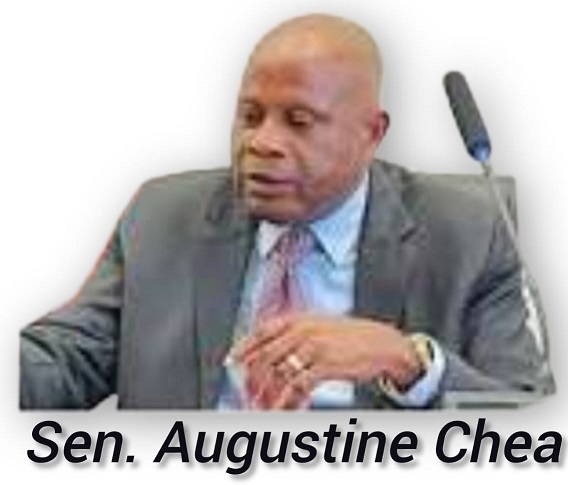
Sinoe County Senator Cllr. Augustine Chea has alarmed that reaction to the acquittal of Samuel D. Tweah raises an important legal question.
"Did the prosecution actually prove its case beyond a reasonable doubt, or are people assuming guilt on the basis of perception" Senator Chea hypothetically inquired.
The Sinoe County Senator who is also a renowned Liberian lawyer said any legal commentators insist that the prosecution proved its case, yet they also claim not to understand why the jury acquitted. That position , according to the Senator reflects weak legal analysis. In criminal law, the issue is never about the crime charged or the duplicitous and colorative language used; the issue is whether every element of every offense charged was proven beyond a reasonable doubt, the legal scholar sitting in the Legislature stressed.
He maintained that the prosecution charged the defendants with offenses including economic sabotage, theft of property, money laundering, and criminal facilitation. Each offense has specific statutory elements that had to be proven with evidence, not assumption, the Senator pointed out.
"The economic sabotage-related charges under sections15.81 and 15.82 of the Penal Law required proof of intentional unlawful misuse, diversion, illegal disbursement, or misapplication of public money" he noted.
Senator Chairman who is a ranking member of the Liberian Senate stressed that theft of property under section 15.51 required proof that the accused knowingly converted or exercised unauthorized control over government property with intent to deprive the government of it.
He further elaborates that Anti-Money Laundering and Countering the Financing of Terrorism Act (AML/CFT Act), 2021 (as amended and related financial crime statutes) required proof that the accused knowingly handled proceeds of criminal activity and intentionally concealed or disguised their illegal origin.
Criminal facilitation, Sen. Chea said under section10.2 required proof that the accused knowingly aided another person in the commission of a crime, and for every one of these offenses, the burden remained proof beyond a reasonable doubt.
Speaking further he stressed that is where a major analytical weakness appears in the legal commentaries surrounding the case.
He said the prosecution called witnesses including two Ministry of Defense officials, a Central Bank official, and an official of the Liberia Anti-Corruption Commission, but an important legal question arises: To prove what exactly, he hypothetically asked.
The accused former Finance Minister Tweah himself acknowledged that his Ministry processed the US$6.2 million payment for election-related security emergency through the Financial Intelligence Agency, and the accused then Acting Minster of Justice and Chair of the Joint Security acknowledged receipt and usage of the money for the intended purpose. If the processing and recept of the money were acknowledged, the legal question is not whether money moved, but whether it was criminally diverted or misused after movement.
So, in addition to these witnesses, the prosecution also needed evidence establishing that the money was not used for national security purposes as claimed, but was instead unlawfully diverted or misapplied by the accused, Senator Chea noted.
"The real issue therefore was whether the prosecution proved beyond a reasonable doubt that: (a) the money was not actually intended for election-related national security operations; (b) the money was unlawfully diverted; and (c) the accused personally converted, stole, concealed, or misused the money for unauthorized purposes" the Senator emphasized.
In other words, he said the prosecution needed to prove criminal diversion or misuse — not merely movement of the money.
Pointing to facts, he said if the defense argued that the money was used for election-related security purposes during a tense and potentially volatile electoral period, then the prosecution’s burden was to disprove that explanation with credible evidence.
That is where the absence of certain critical witnesses becomes significant, he said.
The context also matters. During the 2023 campaign period, the Standard Bearer of the Unity Party, now President Boakai, publicly warned in Grand Bassa that:
“There will be no Liberia if they cheat.”
Statements such as these reflected the tense political climate and fears of election-related unrest at the time. In that context, the defense argument concerning election-security operations could not simply be dismissed without substantial contrary evidence.
But the security threat was not primarily an external military threat involving foreign aggression, like the one we have with Guinea now. Therefore, the key institutions ordinarily responsible for election-related internal security would have included: the Ministry of Justice, the Liberia National Police, and the National Security Agency, rather than primarily the Armed Forces of Liberia.
If the prosecution truly intended to disprove the defendants’ national security explanation, then the more probative witnesses would arguably have been: the former Minister of Justice and Chair of the Joint Security, the former Inspector-General of Police, and the former Director of the NSA. Those officials (even as hostile witnesses) would have been in the best position to testify whether election-security operations existed and emergency operational funding was requested and received, or the disputed money was actually connected to internal security preparations during the elections.
The prosecution therefore needed to do more than establish that money moved through government channels. It needed to prove what happened to the money afterward and establish unlawful conversion, personal benefit, concealment, or intentional criminal misuse by the accused.
If jurors concluded that the prosecution failed to establish those essential links beyond a reasonable doubt, then acquittal was neither irrational nor evidence of misconduct; it was a legally permissible verdict consistent with the constitutional burden of proof.
Instead of examining the statutory elements, evidentiary burdens, witness relevance, and proof gaps, some commentators resorted to theories of jury tampering simply because the verdict did not satisfy political expectations. (I understand the frustration of Cllr. Lafayette B. Gould Sr.)
But juries are not required to convict on suspicion or public pressure. Their duty is to determine whether the prosecution satisfied the constitutional burden of proof. If reasonable doubt remained concerning the actual use of the money or the existence of criminal intent, acquittal was entirely consistent with criminal law principles.
Before accusing jurors of bribery, legal commentators should first do what legal training demands: identify the issues, define the offenses, analyze the evidence, examine what was not proven, and determine whether the prosecution actually established guilt beyond a reasonable doubt. Without that analysis, claims that “the prosecution proved its case” amount less to legal reasoning than to political dissatisfaction with the verdict.
The Judiciary must be insulated from political pressure if it is to perform its constitutional role effectively. The courts and jury system remain a key safeguard of individual liberty and constitutional order.
At the same time, judicial actors bear an even greater duty to resist political influence and to firmly uphold the independence of the courts without compromise."