By Nvasekie N, Konneh
The first time I developed consciousness about name is when I read the Autobiography of Malcolm X. The Nation of Islam members were encouraged to drop their last names which they said represented "slave master's names." They were told to use X in place of their last names until they can find suitable African names. The nation might seen name like Muhammad or Shabazz as African names because over 25% of slaves from West Africa were Muslims. There was a believe that their forebears were Muslims before they were brought on the slave ships to America. Once in America, they were stripped of their authentic African identities which included their names. As such, members of the organization were encouraged to replace their last names with an X until they found an authentic Muslim/African names.
It is upon reading this book and the argument it presented about names that I began to seriously look at my name and what it means. At home, my family called me Nvasekie. In Madrassa or school, I was Sedekie or Siddiq. It is then I became more conscious about changing my name to something authentically African. It dawned on me that though Arabic in origin, my people have Africanized many Arabic names such Siddiq as Nvasekie, Abdullah as Ngoamilleh, Mohammed as Vamuadee, Mamadee, Vamalee, Ousman as Vazoumana etc. I am not sure how these names became Africanized by out people. I don't know if it was a matter of African consciousness that gave birth to these African variations of original Arabic names. I am not aware of any such campaign among my people. Whatever the situation might have been, it's great we have these African variations of originally Arabic names.
Another reason I decided to maintain my name is the reverence I have for the man I am named after. He was the father of my beloved grandmother. He was my mother's grandfather. As it is traditional or cultural among the Mandingoes, we are usually named after some bodies in our families whether from our father's side or mother's side. We also name our children after our best friends who we have great respected admiration for. In our culture, names are not given randomly. In most cases, the father and mother of the child must consult elders in the family about who to name their children after.
It is interesting to note that within our own African Muslim tradition, majority of our women maintain African names such as Machemeh, Mabana, Wata, Manyamouy, Muafetta, Muasia, Banacee, Muakan, Muakon, Fanagbeh, Benani, Fanta or Fanda, Khakon, Mandou etc.
In the late 70s to the 80s, there were active Wahabis movements in our community vigorously campaigning for our people to go to the Arabic original of these names. Such campaign was spearheaded by scholars who had studied in Saudi Arabia and other Middle Eastern countries. They told our people that they must go back to the original "Arabic Islamic names." Some people did but many refused.
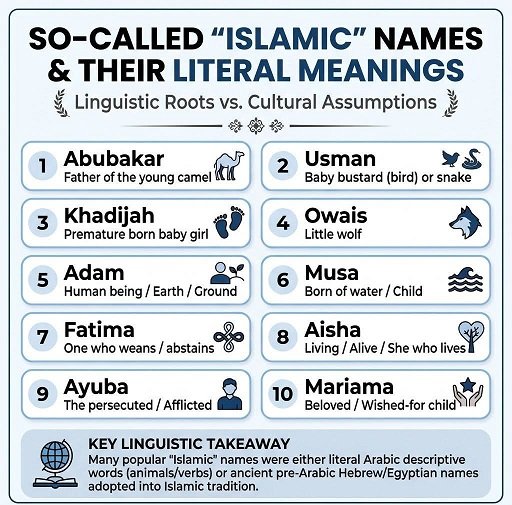
Now compare our African Muslim names to the Arabic names many of us still carry. Look at the meanings of these Arabic names as indicated by the photo below. What is so special about these Arabic names that we are forced to carry as African Muslims? Can our acceptance of Arabic names as Muslims be compared to African Christians adopting European names such as Thomas, Peter, William, Washington, or Edward? Is there any Africanized version of any of these European names among African Christians?
If truth must be told, as Africans, we are either under the yoke of European or Middle Eastern cultural imperialisms.
I shared this piece as a post on my Facebook account. Since then it has generated so much responses. One of the responses I find very interesting to share here for my readers.
"Thanks a lot, Mr. Konneh, for this writeup. I have read and admired almost all of your articles, including this one. However, this particular article prompted me to share my observations on a few points.
1. You said: “What is so special about those Arabic names?”
The main virtue is not the name itself, but the virtue and personality of the individual to whom the name is originally traced (a Prophet, Messenger, Companion, etc.). There is no doubt that our religious teachings have taught us that they were good and pious people who were close to the Almighty. Therefore, we are encouraged to love and imitate them, and that is why such names are special.
Note: Not every Arabic name is special simply because it is Arabic. Rather, it becomes special when the person who originally bore the name was special by virtue of his character and religious status.
2. You wrote: “Can our acceptance of Arabic names as Muslims be compared to African Christians adopting European names?”
No! The two cannot be compared, as they are fundamentally different in several ways.
a. The origin of adopting these names
When you look closely, you will find that these Arabic names were not forced upon African Muslims through torture, slavery, authority, or other forms of coercion. Rather, they were adopted through religious acceptance and persuasion by callers to Islam over the years.
African Muslims willingly chose these names because they believed doing so was an expression of their love for and desire to imitate the Prophets, Messengers, and Companions who originally bore them.
However, in the case of African Christians, many European names were originally imposed on Africans through slavery and other forms of force, without their willingness to bear those names. One common example is Toby in Roots. He was forced to drop his African name which was Kunta Kinte to be called Toby.
b. The effect on family names
The adoption of European names by African Christians did not only result in the adoption of European first names; in many cases, it also changed their family names. This is different from the case of African Muslims. Although they adopted Arabic first names, they generally retained their original African family names.
Why? Because Islam clearly emphasizes that people should be identified by their father's or family name.
Note: The general principles of naming in Islam are:
1. Choose a name with a good and acceptable meaning, whether Arabic or non-Arabic.
2. Avoid names involving shirk or servitude to other than Allah, whether Arabic or non-Arabic.
3. Avoid names with bad, offensive, or shameful meanings.
4. Avoid names that are exclusive to Allah.
5. Prefer good Islamic names, especially the names of Prophets and righteous people.