-Honest Confession Or Warning Of Broken Promises?
Courtesy: Smartnews online
Is Information Minister Jerolinmek Matthew Piah’s declaration that no government can solve all of Liberia’s problems within six years an honest acknowledgment of the country’s development challenges, or an early attempt to prepare Liberians for the possibility that President Joseph Boakai may fall short of his campaign promises?
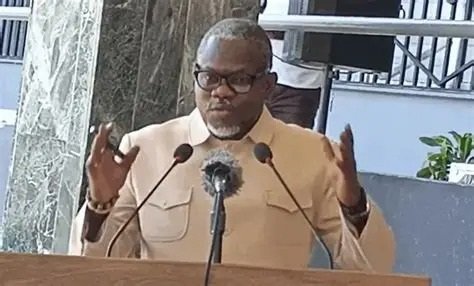
The question has emerged following Piah’s October 22, 2026, remarks at the Ministry of Information’s regular press briefing, where he defended the Boakai administration against criticism over its development record and the President’s participation in the 81st United Nations General Assembly.
Piah argued that Liberia’s challenges are too enormous for any single administration to resolve within one six-year term, emphasizing that successive governments must preserve existing gains and build on the work of their predecessors.
In principle, the argument is reasonable. Liberia’s infrastructure deficits, unemployment, poverty, and weaknesses in public services developed over many years and cannot all be eliminated overnight.
But Piah’s statement raises a more uncomfortable question for the government: If the administration cannot solve every problem within six years, how much progress can Liberians reasonably expect it to deliver on the specific promises that brought it to power?
That is the distinction the government must address.
A CONFESSION OF LIMITATIONS OR AN ATTEMPT TO LOWER EXPECTATIONS?
Piah’s remarks could be interpreted as a realistic acknowledgment that national development requires more time than a single presidential term.
However, coming as the Boakai administration approaches the end of its third year, the statement also invites scrutiny over whether the government is preparing the public for unmet expectations.
Liberians did not necessarily expect the President to eliminate every national problem within six years. But campaign promises create legitimate expectations that a government will make measurable progress on the priorities it placed before voters.
The administration campaigned on improving governance, addressing corruption, strengthening public services, and tackling the country’s longstanding development challenges.
Among the most memorable commitments was Boakai’s promise that vehicles would no longer become stuck in mud on the country’s highways within his first 100 days in office.
Yet reports of poor road conditions, particularly in parts of southeastern Liberia, continue to raise questions about progress on that commitment. Public concerns have also extended to education, healthcare, employment, and the reliability of essential services.
These problems do not, by themselves establish that government has accomplish nothing. They do, however, make it reasonable to ask which commitments have been fulfilled, which remains outstanding, and why.
The issue is not whether Boakai can fix everything. It is whether his government is delivering on the priorities it promised to address.
THREE YEARS IN POWER: WHERE IS THE MEASURABLE PROGRESS?
By October 2026, the Boakai administration had been in office for approximately two years and nine months. The period does not mean every major infrastructure project should be complete. Large projects require planning, financing, procurement and implementation.
Nevertheless, the government should be able to demonstrate tangible progress through completed projects, published expenditure records, improved public services and measurable outcomes.
For example, Liberians deserve answers to several questions:
Roads: which major road prpjects has the government completed and what measurable progress has been made toward access to remote communities?
Education: what has the government achieved in addressing teachers’ welfare, schools disruption and the quality of public education?
Healthcare: what improvements have been made in access to medical facilities, staffingand essential medicines?
Employment: What measurable results have government programmes produced in creating jobs and economic opportunities?
–Governance: What progress has been made in fighting corruption, strengthening public institutions, and ensuring accountability?
POLITICAL
The greatest concern arising from Piah’s statement is not his acknowledgment that Liberia faces enormous challenges. It is the possibility that the six-year argument could become a convenient response whenever citizens question the government’s performance.
A presidential term is constitutionally limited, but that limitation does not suspend accountability.