-NaFAA Empowers W. Point Fish Seller
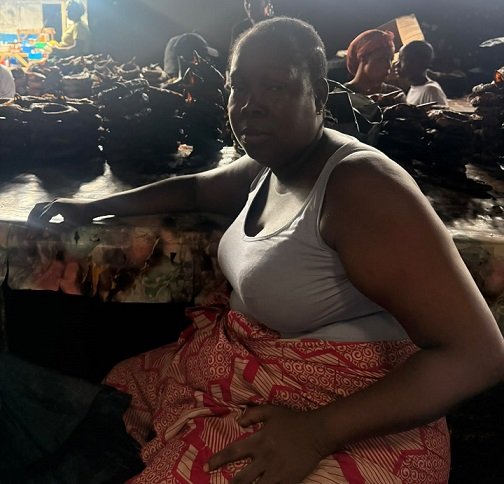
For 45-year-old Ellen Doe, selling fish in the busy West Point community of Monrovia, it is more than a way to earn a daily living. It is an opportunity to become financially independent, expand her business, and provide a better future for her four children.
Doe, a recipient of a US$1,000 grant from the National Fisheries and Aquaculture Authority (NaFAA), says the financial support has helped her move away from buying fish on credit and take greater control of her business.
Before receiving the grant, Doe depended on suppliers, who allowed her to collect fish on credit and repay them after making sales at the local market. The arrangement often left her with limited profits and financial uncertainty.
“Before, I used to go in the market to buy fish on credit to sell,” Doe said. “But this time I don’t do that. I start doing my own thing now.”
With the grant, Doe purchased different types of fish, including Saint-Pierre, Kutu, and Naplae, allowing her to stock her business without relying on credit from suppliers.
She said the change has helped her improve her earnings and better manage her family’s financial needs.
The mother of four now uses her income to support her household, pay her children’s school fees, and cover medical expenses.
“I can help my family, take care of me, sending me to hospital, my children’s school fees and plenty things with money,” Doe said.
She added that all four of her children are currently attending school and expressed appreciation to NaFAA for the support.
“I tell NaFAA thank you over and over, and I want for them to come and rescue me more and more,” she said.
Supporting Women in the Fisheries Sector
Doe’s experience is part of a broader initiative under the Liberia Sustainable Management Fisheries Project (LSMFP), which seeks to strengthen women’s participation in Liberia’s fisheries sector.
Abraham W. Dioh, Project Coordinator for the LSMFP, said the grant program falls under Component 2.2 of the project and targets women-owned businesses, from informal microenterprises to formally registered small businesses.
Dioh noted that women play a significant role in Liberia’s fisheries value chain, particularly in fish processing, preservation, and marketing.
According to him, more than 1,670 women across Grand Cape Mount, Bomi, Montserrado, and Grand Bassa counties have received financial assistance through the project.
The grant program was implemented by Conservation International under the technical oversight of NaFAA.
Dioh explained that the process began with community awareness campaigns and public radio announcements to inform women about the opportunity and encourage applications.
The first funding round attracted more than 6,000 applicants.
Applications were reviewed by an evaluation panel comprising representatives from civil society, the fisheries sector, and NaFAA.
Grant amounts varied according to the size and needs of each business. Smaller vendors could apply for amounts ranging from US$50 to US$100, while applicants seeking larger grants were required to meet additional criteria, including formal business registration where applicable.
Promoting Accountability and Business Growth
To encourage responsible use of the funds, the project introduced a performance-based installment system for beneficiaries receiving grants in multiple payments.
Under the arrangement, recipients had to demonstrate that they had properly used their initial funds before receiving subsequent installments.
Dioh said the approach was designed to promote accountability and help women build sustainable businesses rather than depend on one-time financial assistance.
The project’s monitoring and evaluation team at NaFAA also conducts regular field visits to assess beneficiaries’ business growth and operational stability, working alongside Conservation International.
Looking Ahead
Although the long-term impact of the grants will depend on beneficiaries’ ability to reinvest their earnings, maintain access to markets, and sustain their businesses, Doe’s experience illustrates how access to working capital can help women overcome financial barriers.
For Doe, the US$1,000 grant has provided an opportunity to operate her fish business with greater independence while meeting some of her family’s essential needs.
Her experience also highlights the role women entrepreneurs play in Liberia’s fisheries sector and the potential for targeted financial support to strengthen small businesses and improve household livelihoods.