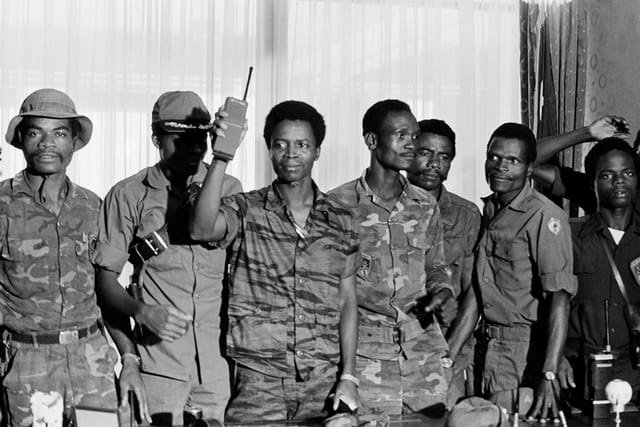
HOW THE MILITARY BLOCKED THE PROGRESSIVE
--FOR TAKING STATEPOWER
The date of the coup for the military takeover was April 12, and the year remains 1980, but before the coup, the Progressive and the Military could drink from the same fountain or reservoir of knowledge but from different interval. The progressive was opened to discuss and plan with the military, but the military had a secret motive (Plan B) which they have refused to share or disclose with the progressive.
While the Progressive Alliance of Liberia (PAL) and the Movement for Justice in Africa (MOJA) adopted a philosophical and metaphysical approach for a change of a recurrent system of 133 years of dominance rule through evolutionary creeds, violent revolution was despised, and the manifesto sought a simple idea of involving enlightenment, which induced the ideal of building a constituency among the intelligentsia and a spirit of tranquility, with government as the medium of alteration and transformation, the military was cleverly observing and looking for a medium through which they would seize state power and later turn against ranking members of the Progressive.
This culture of betrayal of confidence by the military has driven lots of ranking members of the progressive to exile, including Dr. Togba Nah Tipoteh and Mr. G. Barcus Matthews and others out of Liberia for years as they were charged with treason, sedition and other unbailable politically motivated criminal offenses by the government. Head of States, Doe had also extended his power-consolidation witch-hunt to most of his PRC’s members through allegations of fake coup attempts.
While the military was fighting the Progressive during their five years interim period, thereby preventing them from taking state power, the Progressive as a unit have already split in their ideology to obtain state power.
In the first post-war special election organized and held in 1997, the Progressive, instead of putting forth a single candidate, she (progressive) had dumped three candidates in the race. The Progressive had Dr. Tipoteh on the LPP’s ticket, Mr. Matthew on the UPP’s ticket, Dr. Boaima Fahnbulleh on the Liberia Reformation Party (LRP’s) ticket, and the rest is history.
The failure of the Progressive to amalgamate their strength in a single ideologue to neutralize opposing military intrusion has given Samuel K. Doe and Mr. Charles G. Taylor the opportunity to take the Presidency under intermittent military cohesion. Mr. Charles Taylor used the military indirectly with intimidation to get the presidency because the 1997 Special Election that brought Mr. Taylor to power was never held under a peaceful political environment and atmosphere.
At the time of the special election, Mr. Taylor had 90% of the country under his command or authority as a rebel leader, and the National Patriotic Front of Liberia (NPFL) fighters still had guns in their possessions. even though, he (MR. Taylor) had left his greater Liberia comfort and moved over to Monrovia and had his rebel movement metamorphosed into political party like other warring factions did.
The second post-war election held in 2005, the Progressive could not learn from their past political blunder made in the 1997 Special Election, where they had three persons in the race. This time around, they had Dr. Tipoteh on the LPP’s ticket again and Dr. Due Mason on the National Democratic Coalition (NDC).