By Nvasekie N. Konneh
In Liberia, you often come across people who pride themselves for not "speaking any dialect." They don't see any redeeming values in their mother tongues, whatever that be. Such notion is based on ignorance, not knowing the difference between language and dialect. Dialect is defined as a "particular form of a language which is peculiar to a specific region or social group." Example of dialect is Koloqua spoken in Liberia or Pidgin English spoken in Nigeria. Both Koloqua or Pidgin are different from the standard version of the English language which is spoken with different accents representing different places. For instance, the American English has an accent that’s quite different from the English in England. American English originated from England. What is now America was once a British colony. Same could be said of the English spoken in Liberia, Sierra Leone, or Nigeria.
Our indigenous languages such as Mandingo, Lorma, or Gio are not dialects to English or French. They are languages just like English or French. Many of our languages are cross border languages as well. Mandingo is one of the most widely spoken languages in West Africa. It is spoken by more than ten million people in more than ten West African countries. For instance, in Ivory Coast, it is called Dioula. In Guinea, it is called Mandenkakan, or Koniaka, and in Mali, it is Bambaran. Though spoken with different accents in these countries in West Africa, the speakers understand each other.
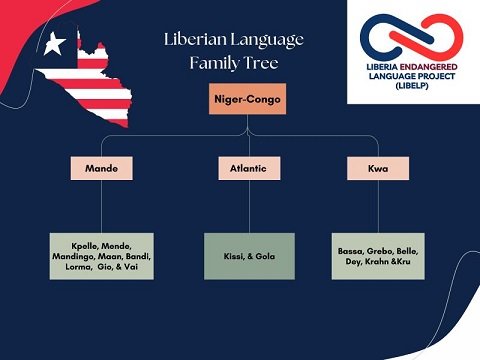
Languages such as Kpelleh, Lorma, Kissi, Mano are spoken in Liberia and Guinea. Gio, Krahn, Kru, Grebo are spoken in Liberia and Ivory Coast. There are dialects of those languages spoken in Guinea, Liberia and Ivory Coast but overall, the speakers do understand each other.
Next time when someone ask you about your language, don't tell them "I don't speak my dialect." Simply say, "I don't speak my indigenous language." We must be ashamed of ourselves for not speaking our languages, falsely thinking that speaking English is equivalent to "civilization." If you think so you have been ignorant or brainwashed.
As a result of colonization by the Europeans, many Africans, especially the “educated ones,” can only speak fluently in English, French, Portuguese, and Spanish etc. Countries such as Guinea, Ivory Coast, Sierra Leone, have hundreds of languages but the official languages are the languages we inherited from European colonization. With our culture and every day experience being influenced by the colonial languages, is there any hope for the preservation of our African languages? The answer is a resounding yes. Efforts are being made to preserve our languages. Some are spoken alongside the colonial languages in various countries. For instance, in Guinea and Ivory Coast, though French is the official language, Mandenkakan, along with Soso, and Fula are widely spoken. In Ivory Coast, Dioula is widely spoken alongside French. In some efforts to preserve the African language, an organization like African Academy of Languages was born and now headquartered in Bamako, Mali.
ACALAN
ACALAN stands for the African Academy of Languages (ACALAN). According to information on its website, ACALAN is a Pan African institution dedicated to the preservation of African languages. The organization was founded in 2001 by the former Malian president, Alpha Oumar Konaré. As part of the African Union, its goal is to harmonize “Africa's many spoken languages.” ACALAN was first led by Adama Samassekou, former minister of Basic Education of Mali. Information on its website says that the year 2006 “was declared by the AU as the Year of African Languages.” The interim Governing Board of ACALAN was set up in June of the same year in Addis Ababa, Ethiopia.
According to further information on the organization’s website, “The African Academy of Languages (ACALAN) fosters Africa’s integration and development through the development and promotion of the use of African languages in all domains of life in Africa. The academy seeks to empower African languages, promote use of multiple languages at every level, especially in the education sector and to ensure the development and promotion of African languages as factors of African integration and development, respect for values and mutual understanding and peace.”
After the tenure of Adama Samassekou, ACALAN was led by Prof. Sozinho Francisco Matsinhe of Mozambique from 2009 to 2015. The current head of ACALAN is Dr. Lang Fafa Dampha of Gambia. Dr. Dampha is a prolific writer and advocate for the preservation of African languages.
Bambara (Bamanankan)
As a former French colony, French is widely spoken in Mali. However, since 2023, it has been reported that Mali “removed French as an official language.” French is replaced by indigenous language such as Bambara (Bamanankan). Niger has followed suit with Hausa as one of the ten national indigenous languages. Whether to use indigenous languages in place of the colonizers’ languages has been widely debated in the African intellectual circle for years. According to to the late famous Nigerian writer, Chinua Achebe, “English could carry African stories to the world” but another famous African writer, Ngũgĩ wa Thiong’o argued that “only African languages could truly protect identity and cultures” of African people. Ngũgĩ wa Thiong’o
said that “English, like French or Spanish, is not an African language, and turning it into a measure of identity or superiority only reinforces the legacy of colonial domination.” He went on to say that “societies begin to normalize this mindset when people take pride in mastering a colonial language while neglecting their own.”
He also highlighted the troubling reality that many African children, and even their parents, can no longer speak their mother tongues, yet feel a sense of achievement in speaking English. For him, this was not empowerment but a loss of cultural grounding.
Speaking to God in One’s Mother Tongue
Currently, there is a controversial preacher and imam in Guinea who leads prayer by reciting the Quran in his native Mandenkakan. His name is Imam Nanfo Ismael Diaby. Since Imam Diaby started reciting the Holy Quran in Mandingo, he has faced criticism and even jail time. Even though Arabic is not considered as a colonizers’ language, it is used to recite the verses of the Quran during prayer at home or in the mosques throughout the world. In several Facebook posts, I sided with Imam Diaby in his use of the Mandingo language to recite the Quran during prayers at homes or in the mosques.
In Liberia, we often hear that the Kpelleh and Bassa are the two languages that are widely spoken, but yet, English is our official language. The late President William R. Tolbert was said to have been a fluent speaker of the Kpelleh language. As one of the widely indigenous languages of Liberia, it has been suggested that it becomes the official language of Liberia along with the English language. Whether that happens now or in the future, this only signifies the importance of our indigenous African languages. As such, it is important that we understand that our indigenous languages are not dialects but languages. The more we understand this, the more we will be culturally liberated.