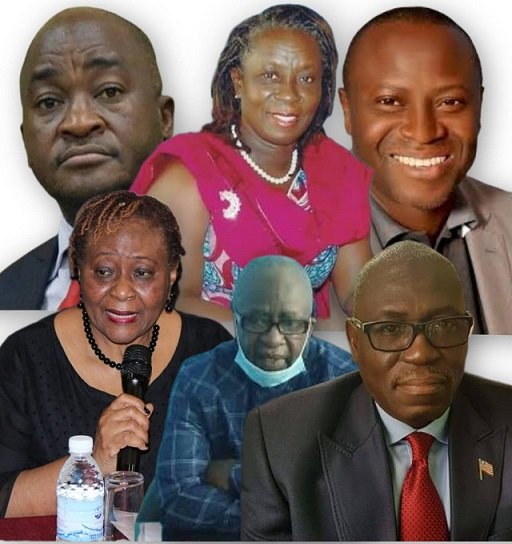
-13 Former Officials and Saudi-Donated Rice
If it is proven beyond reasonable doubt that thirteen former officials of the Weah’s administration actually misappropriated more than twenty five thousand bags of Saudi-donated rice for disaster victims in Liberia, they should be worrying by now as the current government remains unwavering to hold them accountable.
Worried because the matter has already landed before the Criminal Court “C” at the Temple of Justice as part of efforts by the government to recover public assets and hold accountable all individuals accused of diverting the huge consignment of rice intended for disaster victims.
Prominent amongst the accused are former Foreign Minister Dee-Maxwell Saah Kemayah, former Internal Affairs Minister Varney A. Sirleaf, former Deputy Foreign Affairs Minister for Administration, Thelma Sawyer, and former Deputy Internal Affairs Minister for Administration Momolu Johnson.
Others are former National Disaster Management Agency (NDMA) Executive Director, Henry O. Williams, former General Services Agency (GSA) Deputy Director for Operations, Edris Bility, NDMA Director for Disaster Victims, Augustine Kollie, and NDMA employee. Edward S. Konneh.
Also added on the list of defendants are NDMA Communications Director Archievego M. Doe, NDMA Logistics Officer, Rosetta L. Gbassay Bowah, warehouse manager, Evelyn Gbee, GSA Assistant Director,, Mamie Davies, and Wayfa Ciapha, identified as the purported CEO of the Group of Seventy-Seven.
The Kingdom of Saudi Arabia in April 2023 donated the consignment of rice worth approximately 500 thousand United States Dollars to support disaster-affected communities across Liberia.
The consignment was reportedly stored in warehouses managed by the government, but an investigation conducted by the Assets Recovery and Property Retrieval Taskforce (AREPT) allegedly uncovered significant discrepancies in the process.
Findings of the AREPT investigation showed that 25,054 bags valued at roughly US$425,918 were suspected to have been stolen, misapplied, or improperly distributed, therefore landing the thirteen former officials into a legal predicament.
Their charges include theft of property, economic sabotage, misuse of public money, misapplication of entrusted property, abuse of office, and criminal conspiracy.
Following their 2025 indictment and subsequent pretrial proceedings, Criminal Court “C” ruled on August 11, 2026, that the trial would commence at 9:00 a.m. on August 17.
For AREPT, the trial represents a crucial stage in its mandate to ensure public resources are subjected to judicial scrutiny. In a statement issued by Public Relations Officer Joseph F. Daniels, the Taskforce emphasized that an indictment does not establish guilt, noting that the evidence must be tested in court to determine criminal responsibility and potential restitution. AREPT pledged to collaborate with the Ministry of Justice while respecting due process and the independence of the judiciary.
For the Boakai administration, the rice case is a credibility test for AREPT. Cllr. Edwin Kla Martin, head of the taskforce, has denied claims of selective prosecution, but some officials and members of the opposition Coalition for Democratic Change (CDC) have repeatedly accused the taskforce of targeting CDC-era officials like Kemayah, Broh, and Tweah for political optics.
For Judge Feika and Criminal Court "C", the Kemayah trial is now more than a theft case. It is a stress test of the post-Tweah reforms.
On Monday, in a striking contrast, jury selection that took days in the Tweah trial moved with unusual speed — 10 of 15 jurors were selected in a single day. Selection of the remaining five continued Tuesday under tightened sequestration rules: no phones, isolated lodging, and daily contempt warnings.
Politically, it forces the state to try a former Foreign Minister exactly as it tried a former Finance Minister — by peers, in public, and under the same rules that collapsed the last high-profile acquittal.
If AREPT secures a conviction, it will claim validation of its anti-graft campaign. If the jury acquits — or if the verdict is again vacated — Liberia will face a constitutional crisis over what a jury verdict is worth.